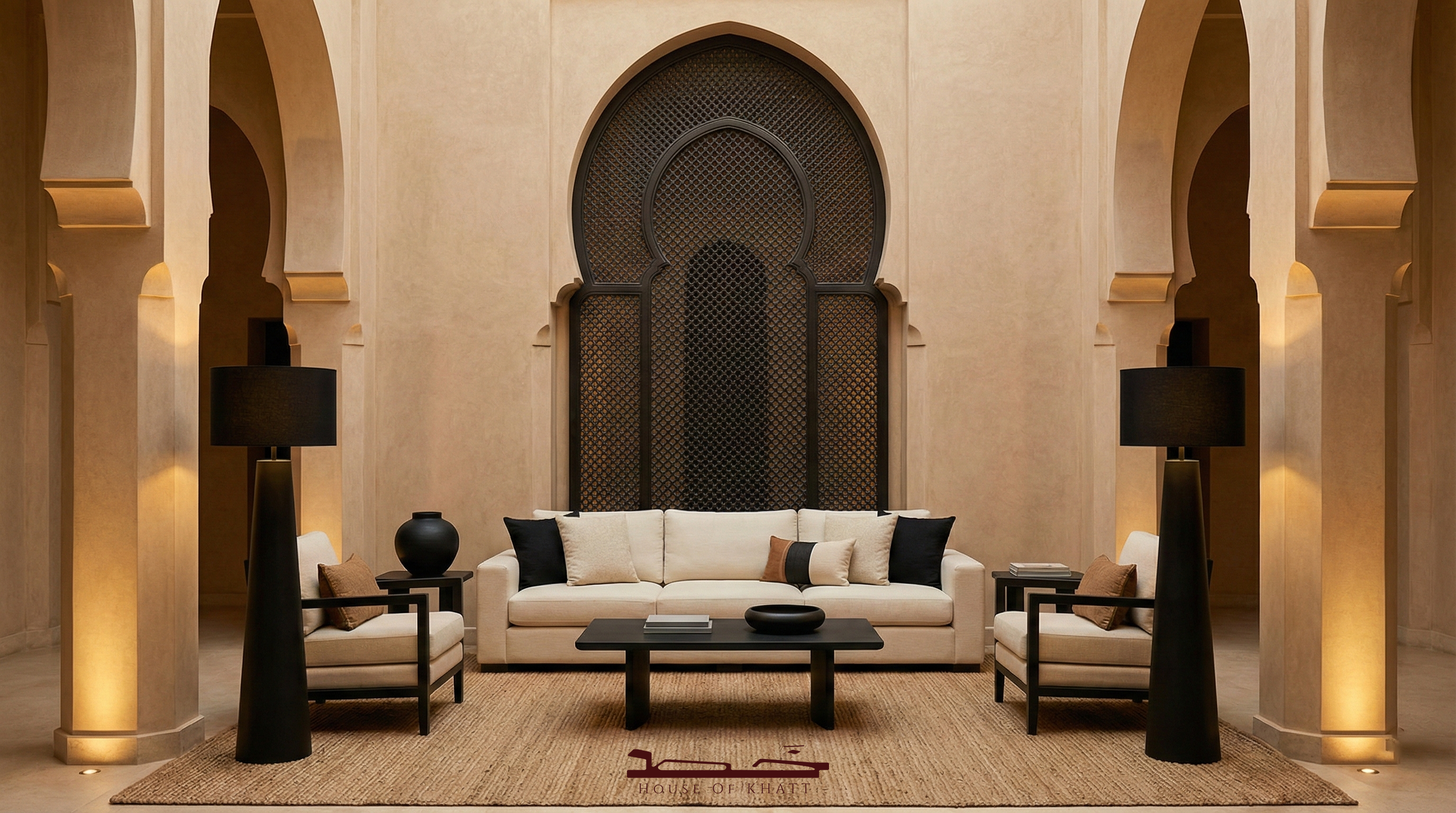
Article: The Contemporary Majlis

The Contemporary Majlis
Tradition in a New Language
The Majlis has never been simply a room.
Across the Gulf, it has long been a place of gathering: where guests are received, conversations unfold, coffee is shared and hospitality takes physical form. Its significance lies not only in how it looks, but in what happens within it.
As the architecture and interiors of the region evolve, so too does the Majlis.
The question is not how to make it more modern. It is how a space so deeply rooted in tradition can continue to speak the language of its time without losing the rituals that gave it meaning.
Tradition Does Not Require Repetition
There is a tendency to approach heritage through imitation.
A traditional pattern is reproduced. A familiar motif is enlarged. An architectural detail from the past is placed within an otherwise contemporary room.
But respecting tradition does not necessarily mean reproducing its appearance.
The Majlis has always responded to its environment, the materials available to it and the social customs of those who gather there. Its contemporary evolution can do the same.
A room can acknowledge its cultural history through the way people are seated, the importance given to conversation, the generosity of its proportions or the objects chosen to inhabit it — without becoming a reconstruction of the past.
Tradition survives not because it remains unchanged, but because each generation finds its own way of carrying it forward.
A Room Built Around Conversation
Perhaps the most important element of any Majlis is not an object at all. It is the relationship between people.
Furniture in a Majlis has traditionally encouraged gathering. Seating faces inward. Distances allow conversation. Tables support the rituals of coffee, dates and hospitality. The room is arranged around exchange rather than spectacle.
This principle remains remarkably relevant to contemporary interiors.
A sculptural sofa may replace traditional perimeter seating. Individual chairs might introduce different forms and materials. Tables can become collectible objects in their own right.
The aesthetic can change completely while the social architecture remains.
This is where contemporary design becomes most interesting: not when it erases the function of the Majlis, but when it gives that function a new physical language.
The Return of the Object
For some time, contemporary luxury interiors were dominated by a particular idea of refinement: neutral palettes, restrained forms and rooms in which almost nothing demanded too much attention.
There is beauty in restraint. But there is also beauty in character.
The Majlis, perhaps more than many other spaces in the home, offers an opportunity for objects to become part of the conversation.
An extraordinary chandelier can transform the ceiling into a focal point. A surreal cabinet can introduce humour. A sculptural chair can hold its own beside an artwork. Bronze, lacquer, carved timber, woven fibre, coloured glass and richly worked metal can bring depth and individuality into the room.
Not every object needs to disappear elegantly into its surroundings. Some deserve to interrupt them.
Ornament Has Always Had Something to Say
Geometry, calligraphy, pattern and extraordinary craftsmanship have long been embedded within the visual cultures of the Islamic world.
Their contemporary relevance does not depend on reproducing them literally.
A designer may respond to geometry through proportion rather than pattern. A craft technique can be preserved while its form is radically reconsidered. Metalwork, carving, weaving or marquetry can carry centuries of knowledge into an object that looks entirely of the present.
This distinction matters. Heritage becomes most compelling when it remains a living source of ideas rather than a catalogue of motifs.
The dialogue between past and present can be subtle or spectacular. What matters is that it feels considered rather than applied.
The Majlis as a Collection
There is another way to imagine the contemporary Majlis: not as a perfectly coordinated interior, but as a collection.
A room assembled gradually can hold different periods, origins and creative voices.
An inherited object might sit beside contemporary collectible design. A work by a regional artist can share a room with furniture commissioned from an international maker. Something highly decorative might coexist with something almost austere.
They do not need to match. Their relationship can come from the person who chose them.
This approach allows the Majlis to become deeply personal. Rather than presenting a complete aesthetic purchased at once, the room begins to reveal encounters, histories and interests. The interior acquires a biography.
The Importance of the Statement
Large Majlis spaces can carry objects with considerable presence.
Scale matters, but presence is not simply a question of size.
Sometimes a single unexpected object can change the character of an entire room.
A chandelier suspended low enough to be experienced rather than merely seen. A cabinet that approaches sculpture. An expressive pair of candleholders on an otherwise formal table. A work of art positioned where architecture would traditionally provide ornament.
These objects become points around which the eye — and sometimes the conversation — gathers.
This is particularly relevant to collectible design, where furniture and objects increasingly occupy territory once reserved exclusively for art. Function does not diminish their expressive potential. It gives us another way to encounter it.
A Living Tradition
The contemporary Majlis does not need a prescribed aesthetic.
It can be restrained or exuberant. Architectural or decorative. Contemporary or layered with antiques. It can celebrate local craftsmanship, international design, family objects and contemporary art within the same room.
What gives it continuity is something deeper than style: Hospitality, Gathering, Conversation, Generosity.
The ability of a space to bring people together.
At House of Khatt, we are interested in what happens when objects with strong individual identities enter spaces with histories and identities of their own. The Majlis offers an especially rich setting for that conversation.
Because perhaps the most meaningful way to preserve a tradition is not to freeze its appearance. It is to allow it to continue evolving.

Leave a comment
This site is protected by hCaptcha and the hCaptcha Privacy Policy and Terms of Service apply.